Rural Health Transformation Program · State Procurement & Funding Profile
Maryland's $168.18M first-year Rural Health Transformation Program award — the largest per-rural-resident award in the country — including the three-pillar plan, the MDH team and issuing partners, the RFA wave, with a dated log of official activity.
Maryland’s official RHTP hub →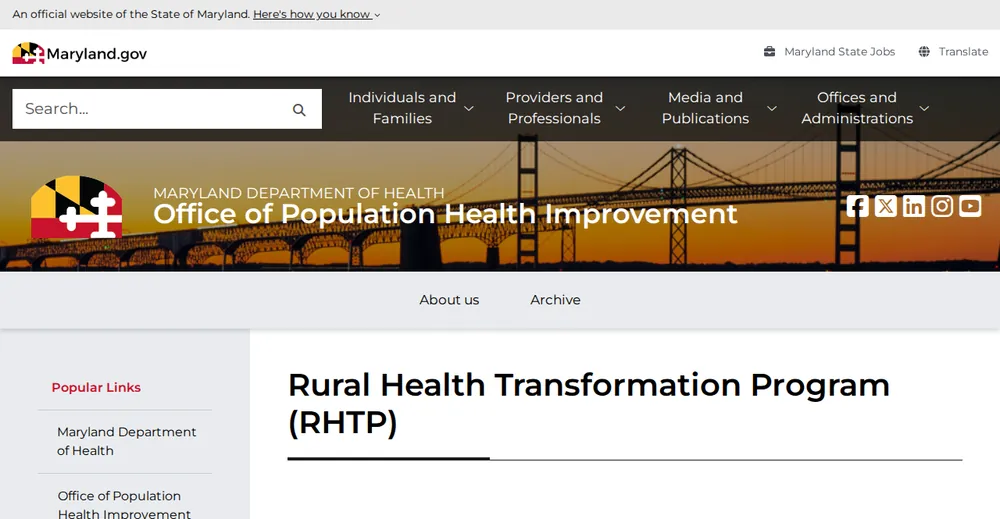
Maryland's Budget Period 1 Notice of Award came in at $168.18 million (about $168.2M), 100% CMS-funded — 84 percent of what the state requested, and roughly double the national average measured per rural resident. CMS released the funds on February 25, 2026. It is Year 1 of the five-year federal $50 billion program, part of a proposed roughly $1 billion Maryland allocation over five years.
The Maryland Department of Health (MDH), through its State Office of Rural Health, administers the program, with a designated Rural Health Transformation Committee reviewing and approving funding requests quarterly. Maryland delegates delivery to issuing partners — the Maryland Health Care Commission (primary care), CRISP the state HIE (telehealth and connectivity), Garrett County Health Department (revenue-cycle TA), and the Maryland Department of Labor (workforce). Program contact: jamie.cardillo@maryland.gov; general questions route to mdh.transformruralhealth@maryland.gov.
Maryland's plan runs on three pillars: Transform the Rural Health Workforce (apprenticeships, AHEC expansions including a first-ever Southern Maryland AHEC, physician and advanced-practice recruitment); Promote Sustainable Access and Innovative Care (primary, specialty and behavioral health capacity, school-based health centers, HIT connectivity, telehealth infrastructure, mobile health, and value-based care); and Empower Rural Marylanders to Eat for Health (post-harvest infrastructure, food hubs, and healthy-food access in rural "hunger hot spots"). The through-lines are the state's global-budget transition and population health.
As of mid-July roughly $134.5M of the competitive-procurement pool had yet to be solicited. The full breakdown is in Maryland's budget narrative.
Procurement has come in waves through the issuing partners. Currently open: a Maryland Department of Labor RFA covering Pathways to Health Careers ($3.7M) and RISE ($16.4M) across 18 designated rural counties, plus CRISP's first-come, first-served Rural Health Connectivity Program paying rural HIPAA-covered providers up to $40,000 each for new ADT, CCD and InContext connections. Earlier solicitations included PHPA 3936 (Pillar 2), Rural Maryland Council food-system grants (Pillar 3), an MHCC primary-care expansion opportunity ($6.3M), a CRISP telehealth-blueprint consultant, and a Garrett County revenue-cycle TA contract; the MDA Post-Harvest Cold Storage grant (closed June 14) and Garrett County Insurance Contracting RFA (closed June 15) have expired. The dispatch list below carries the running record.
Near-term dates: on the Maryland Department of Labor RFA, the Notice of Intent to Apply is due August 7 (1:00 p.m.) and proposals are due August 9 (11:59 p.m.), with awards in September. CRISP held a Rural Health Connectivity webinar July 21. The Rural Health Transformation Committee meets quarterly, with sessions on September 10 and December 11, 2026. Confirm windows on the RHTP procurement page; live dates surface in the dispatches below.
The Rural Health Transformation Program was created by Section 71401 of the One Big Beautiful Bill Act (2025) and is administered federally by CMS. In Maryland, Senate Bill 282 — the $70.8 billion FY2027 operating budget — serves as the appropriations vehicle for the Maryland Department of Health, which received the $168.2M first-year award; MDH's State Office of Rural Health manages implementation under that budget authority, with the oversight committee approving funding requests quarterly.
Eligibility runs on two tracks. Direct-to-state contracts go out as competitive RFAs and RFPs through the issuing partners (MDH, MHCC, CRISP, Garrett County Health Department, Maryland Department of Labor, Rural Maryland Council), where firms bid as prime contractors or consultants. Subawards flow to rural providers — rural hospitals, local health departments, area agencies on aging, FQHCs, school-based health centers, EMS and food-system organizations — where technology vendors and consultants most often engage as subcontractors or implementation partners. With roughly $134.5M still to be solicited against an October 30 obligation deadline, the backlog is the opportunity.
Track opportunities on the RHTP procurement page, monitor the program hub, and route questions to mdh.transformruralhealth@maryland.gov.
Chronology of official activity compiled from automated monitoring of state sources, with personal review and verification. Links to primary documents and related Tracker analysis.
Independent reference profile compiled and maintained by Civic Operator LLC from primary sources (CMS, Maryland .gov program and procurement pages, the Governor's newsroom) and the Rural Health Transformation Grant Tracker. Official-source data and dispatch links refresh nightly; profiles are regenerated weekly from the latest reporting and changes reviewed before publication. Last reviewed 2026-07-30. · Methodology & sources · All states