Rural Health Transformation Program · State Procurement & Funding Profile
Pennsylvania's approximately $193.3M Rural Health Transformation Program award — the six-initiative plan, the administering agency, its first-come program payments, with a dated log of official activity for vendors, providers, and consultants tracking the program.
Pennsylvania’s official RHTP hub →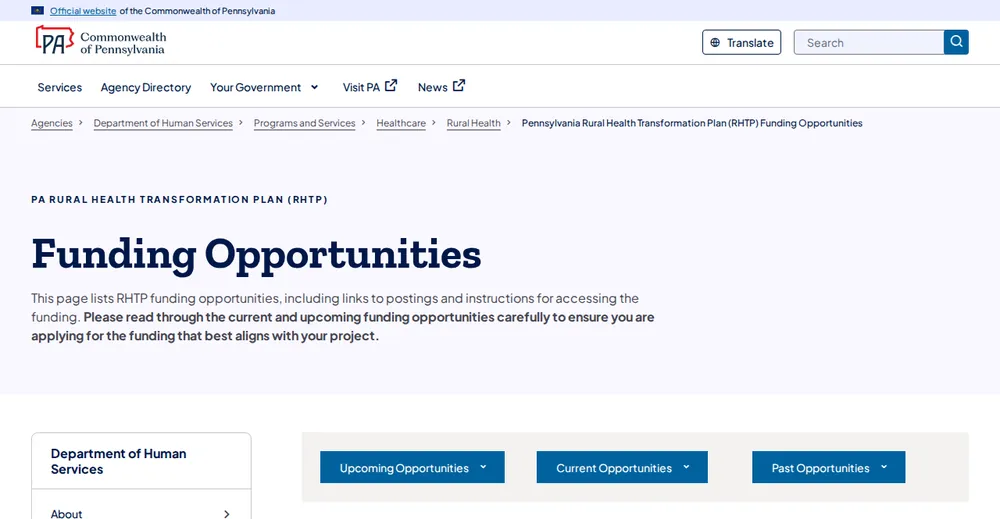
Pennsylvania's Year-1 allocation is approximately $193.3 million, its share of the federal $50 billion Rural Health Transformation Program. CMS structures the program over five years, with a Year-1 allocation followed by additional annual funding. Pennsylvania is sequencing its Year-1 money into discrete channels — a broad $25M Rapid Response Stabilization round followed by targeted technology and provider-type payments — with awarded stabilization funds required to be expended by July 31, 2027.
The Pennsylvania Department of Human Services (DHS) administers the program. Program contact is klb520@psu.edu. DHS is standing up an RHTP Advisory Council of subject-matter experts and regional Rural Care Collaboratives (RCCs) as public planning bodies for the regions.
Pennsylvania's federally approved application is built around six initiatives — Aging and Access, Behavioral Health, Emergency Medical Services (EMS) and Transportation, Maternal Health, Technology and Infrastructure, and Workforce. A defining bet is interoperability: the state is using RHTP dollars to move its fragmented provider base onto a single state-controlled data spine, with five certified Health Information Organizations (HIOs) feeding one statewide hub, the Pennsylvania Patient and Provider Network (P3N) — a prerequisite for care coordination, maternal-health hubs, and remote behavioral health across the plan.
Early Year-1 money has flowed through capped payment channels tied to the six initiatives. The Rapid Response Stabilization round put $25M toward one-time purchases (supplies, equipment, renovations, structural improvements, and ambulance enhancements) at $10,000–$1,000,000 per entity. Two technology tracks then targeted interoperability: a $1.8M FQHC & FQHC Look-Alikes payment (six awards of $300,000) and a $25M EHR & HIO payment for hospitals, long-term care, home health, behavioral health, and community/ICF providers — both funding CEHRT adoption and full P3N onboarding. Recurring focuses on record include rural budget expansion, health IT, EMS, and pharmacy. The full breakdown is in DHS's federally approved RHTP application.
Pennsylvania is running its technology money as non-competitive, first-come, capped program payments rather than scored RFPs, so speed and a complete submission matter more than a competitive proposal. Posted opportunities include the Rapid Response Stabilization round ($25M, eligibility certifications from midnight May 1, closed June 1), the FQHC & FQHC Look-Alikes EHR/HIO payment ($1.8M; applications July 27–August 7), and the broader EHR & HIO interoperability payment ($25M; applications July 27–August 14, or until the cap is met). The running record is in the dispatch list below.
Because these are first-come payments, windows move fast. The two technology tracks open together with a certification webform on July 27, 2026: the FQHC payment closes August 7 and the EHR/HIO payment closes August 14 (each “or until the funding cap is met, whichever comes first”). All Rapid Response Stabilization funds must be expended by July 31, 2027. Current per-opportunity dates surface first in the dated dispatches below and on the funding page.
The Rural Health Transformation Program was created by Section 71401 of the One Big Beautiful Bill Act (2025) and is administered federally by CMS. Pennsylvania administers its award through DHS under its federally approved RHTP application, and structures its technology program payments under Section 203-H of the Fiscal Code. Governance is being built through the RHTP Advisory Council and regional Rural Care Collaboratives.
Eligibility runs on two tracks. Direct-to-state contracts would go out competitively with firms bidding as prime contractors, but much of Pennsylvania's early money instead flows as capped program payments and subawards to rural providers — hospitals, long-term care nursing facilities, home health agencies, behavioral health providers, community homes and ICFs, FQHCs, and EMS. Providers must be located in or serve HRSA-defined rural census tracts or rural county classes 4–8. For vendors and consultants, a key signal is on the record: DHS confirmed that RHTP dollars can pay a third-party consultant to guide an FQHC's CEHRT transition and P3N onboarding — explicitly allowable engagement as an implementation partner. Nominate for the Advisory Council/RCCs and subscribe for opportunity alerts.
Chronology of official activity compiled from automated monitoring of state sources, with personal review and verification. Links to primary documents and related Tracker analysis.
Independent reference profile compiled and maintained by Civic Operator LLC from primary sources (CMS, Pennsylvania .gov program and procurement pages, the Governor's newsroom) and the Rural Health Transformation Grant Tracker. Official-source data and dispatch links refresh nightly; profiles are regenerated weekly from the latest reporting and changes reviewed before publication. Last reviewed 2026-07-30. · Methodology & sources · All states