
Rural Health Transformation Program · State Procurement & Funding Profile
Rhode Island's $156,169,931.19 Rural Health Transformation Program award — the plan, the administering agency, the budget split, live procurements, with a dated log of official activity.
Rhode Island’s official RHTP hub →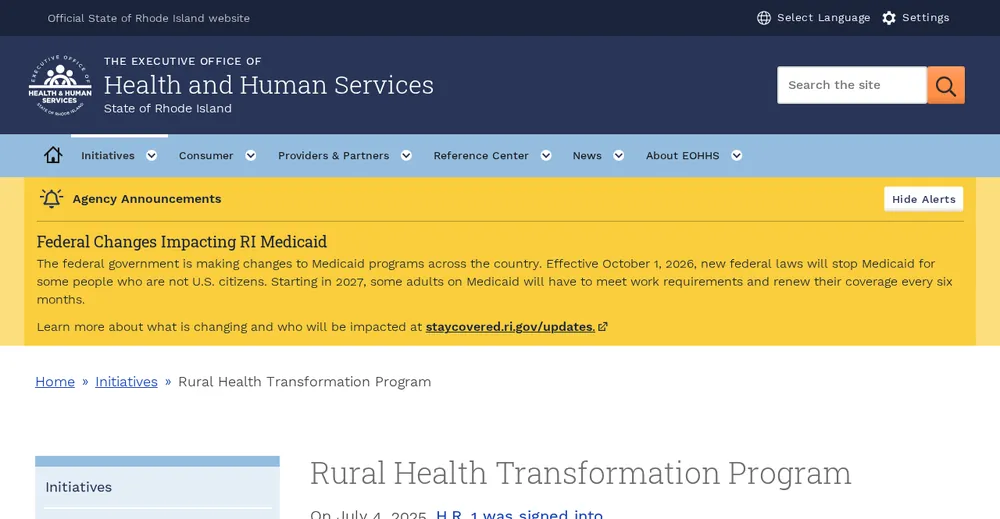
Rhode Island's Year 1 award is $156,169,931.19, its share of the federal $50 billion Rural Health Transformation Program, structured by CMS as a five-year program. The state has filed a $142.7 million budget amendment for SFY 2026–2027 reflecting its spending plan under the Year 1 award following final CMS approval.
The Rhode Island Executive Office of Health and Human Services (EOHHS) leads the program, with all procurements managed by the Rhode Island Division of Purchases and rural health coordination run through RIDOH's Office of Primary Care and Rural Health. Program questions go to RIDOH.OPCRH@health.ri.gov.
Rhode Island's plan is built on five goals: making rural residents healthier by targeting chronic disease, behavioral health, substance use, and maternal, child and oral health; expanding sustainable access to urgent, primary, behavioral and specialty care; strengthening the rural health workforce; accelerating value-based and affordable care models; and integrating technology and HIT infrastructure into rural practice. It plans 13 initiatives in all.
Per Rhode Island's budget amendment, the top-line allocations are:
Additional initiatives span rural access data, provider recruitment, and telehealth; the full breakdown across the 13 planned initiatives is in the state's budget amendment.
The first of Rhode Island's 13 planned initiatives to reach the street was the Administrator for a Health Information Technology (HIT) Rural Infrastructure Fund RFP — a single vendor to deliver technical assistance to rural providers across the state's 18 rural towns plus the Narragansett Indian Tribe and run the financial machinery to push many small subawards out the door. Responses closed July 10, 2026 and are under evaluation; the contract is slated to run September 1, 2026 through 2031, with the first provider subawards due by January 31, 2027. Next up is RHT Recovery Community Centers (FY27). The dispatch list below carries the running record.
Future solicitations are posted on Ocean State Procures; new dates surface first in the dated dispatches below.
The Rural Health Transformation Program was created by Section 71401 of the One Big Beautiful Bill Act (2025) and is administered federally by CMS. Rhode Island's $142.7 million SFY 2026–2027 budget amendment carries the state spending authority, and Governor Dan McKee endorsed the application in a letter to CMS. The award is tied to a state policy-reform package — rolling back Certificate of Need requirements, expanding scope of practice for pharmacists and dental hygienists, and joining interstate licensure compacts — all conditions to keep the full federal award flowing.
Eligibility runs on two tracks. Direct-to-state contracts go out as competitive solicitations through Ocean State Procures, where firms bid as prime contractors — as with the HIT Rural Infrastructure Fund Administrator role, which demands a vendor able to float $10 million-plus in provider subawards each year pending state reimbursement. Subgrants and subawards flow to rural providers across the state's 18 rural towns (each under 25,000 residents) and the Narragansett Indian Tribe; named early subrecipients include Block Island Health Services, the Care Transformation Collaborative of Rhode Island, the Hospital Association of Rhode Island, the RI League of Cities and Towns, and the Rhode Island Health Center Association. Vendors and consultants engage as subcontractors or implementation partners.
Register on Ocean State Procures (search “rural health”), complete the state's interest survey, and watch the RHTP hub and its Rural Stakeholder Advisory Council.
Chronology of official activity compiled from automated monitoring of state sources, with personal review and verification. Links to primary documents and related Tracker analysis.
Independent reference profile compiled and maintained by Civic Operator LLC from primary sources (CMS, Rhode Island .gov program and procurement pages, the Governor's newsroom) and the Rural Health Transformation Grant Tracker. Official-source data and dispatch links refresh nightly; profiles are regenerated weekly from the latest reporting and changes reviewed before publication. Last reviewed 2026-07-30. · Methodology & sources · All states