
Rural Health Transformation Program · State Procurement & Funding Profile
Virginia's $189,544,888.14 first-year Rural Health Transformation Program award — the "VA Rural Vitality" plan, the DMAS-led partner model, the workforce and tech initiatives, with a dated log of official activity.
Virginia’s official RHTP hub →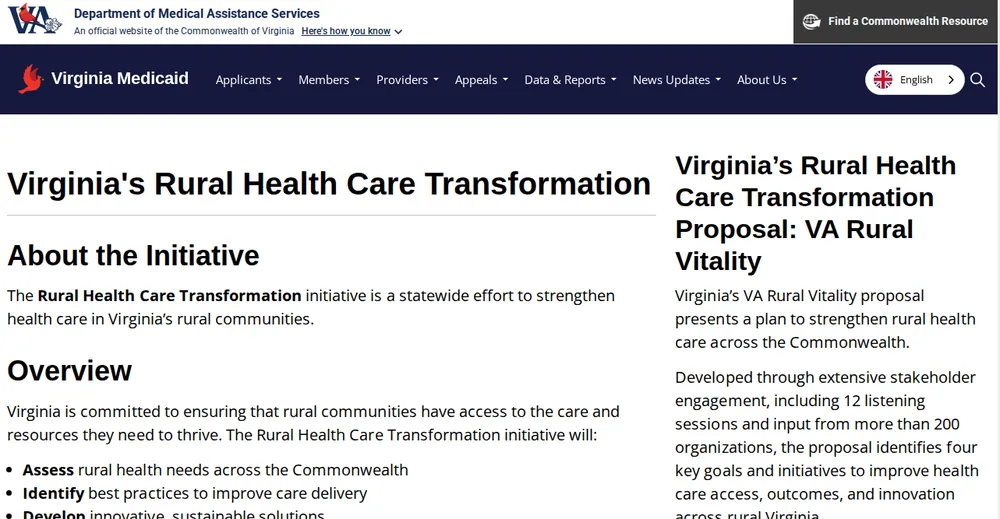
Virginia secured a confirmed federal award of $189,544,888.14 for the first budget period of the five-year Rural Health Transformation Program — its share of the federal $50 billion program. Branded "VA Rural Vitality," the effort is a five-year strategic investment plan, with additional annual awards expected in each funding year.
The Department of Medical Assistance Services (DMAS) is the lead state agency and primary recipient of the CMS cooperative agreement, providing oversight and ensuring federal compliance. Virginia uses a named subrecipient model, delegating administration of specific funding streams to "Key Implementation Partners" that release downstream RFAs. Program contact: ruralhealth@vdh.virginia.gov; hub at ruralhealthtransformationva.virginia.gov.
VA Rural Vitality targets Virginia's 76 rural counties — the "rural horseshoe," 57% of the Commonwealth's counties and about 1.5 million residents. The plan front-loads workforce development to address clinician shortages and pairs it with a major technology-modernization push, delivered through established implementation partners rather than a single central office. The named tags are clinical transformation, rural residency, and mobile primary care.
These are multi-year proposed budgets; the full Year-1 breakdown is in Virginia's project and budget narratives on the funding page.
Virginia runs a partner-led model in which Key Implementation Partners — the Virginia Hospital Research and Education Foundation, the VCCS Foundation, Virginia Works, and the Virginia Department of Education — issue downstream RFAs to local providers and organizations. As of mid-2026 the state is transitioning from Phase 1 (partners established and contracting) to Phase 2 (identifying administrators for its access and wellness initiatives). Specific solicitation numbers and amounts had not yet been detailed publicly; the dispatch list below carries the running record.
Virginia has not published concrete application windows in the sources on record; because RFAs are released by the individual implementation partners as the state moves from Phase 1 to Phase 2, deadlines surface first in the dated dispatches below and on the DMAS Rural Health Transformation page.
The Rural Health Transformation Program was created by Section 71401 of the One Big Beautiful Bill Act (2025) and is administered federally by CMS. Virginia administers its award through DMAS as the primary recipient of the CMS cooperative agreement, delegating funding streams to named Key Implementation Partners under its CMS-approved plan.
Eligibility runs on two tracks. Direct-to-state contracts and partner agreements position Key Implementation Partners (VHREF, the VCCS Foundation, Virginia Works, VDOE) as the entities receiving and re-releasing funds, and firms can bid as prime contractors where the state or a partner competes work. Subawards flow through those partners to rural providers — rural hospitals, residency sponsors, community colleges, apprenticeship employers and local organizations across the 76-county rural horseshoe — where technology vendors and consultants most often engage as subcontractors or implementation partners.
Track opportunities on the VA Rural Vitality hub and the DMAS Rural Health Transformation page, and direct questions to ruralhealth@vdh.virginia.gov.
Chronology of official activity compiled from automated monitoring of state sources, with personal review and verification. Links to primary documents and related Tracker analysis.
Independent reference profile compiled and maintained by Civic Operator LLC from primary sources (CMS, Virginia .gov program and procurement pages, the Governor's newsroom) and the Rural Health Transformation Grant Tracker. Official-source data and dispatch links refresh nightly; profiles are regenerated weekly from the latest reporting and changes reviewed before publication. Last reviewed 2026-07-30. · Methodology & sources · All states